

From Candidates to Trainers: Inside Dronum India Aviations TTT Journey and July 2026 Viva Results
India’s drone industry is growing at a pace that demands more than good technology. It needs good people, better training systems and, most importantly, capable trainers who can prepare the next generation of drone professionals.
At Dronum India Aviations, we believe that a trainer’s responsibility goes far beyond explaining how a drone flies. A trainer must understand the technology, safety procedures, operational practices and regulatory framework—and must also be able to communicate that knowledge effectively to someone who is learning it for the first time.
This philosophy formed the foundation of our Train-the-Trainer (TTT) programme and the preparation undertaken for the DGCA Remote Pilot Instructor (Rotorcraft–RPAS–Small Class) Oral Examination conducted in July 2026.
The journey was not simply about preparing candidates for a viva. It was about preparing them to take on a larger responsibility within India’s rapidly developing drone ecosystem.
1. Dronum India Aviations: Building Skills for a Growing Drone Industry
Dronum India Aviations is a DGCA-approved drone training and systems organisation headquartered in Jaipur, Rajasthan, with operations spanning drone training, assembly, system integration, testing, Drone LAB and RPTO-compliant infrastructure development. The organisation also works in procurement, consultancy, drone supply, service and operational capability development, collaborating with Indian defence forces, internal security agencies, government departments, academic institutions and industry partners to support compliant and operationally effective use of drone systems.
Dronum is also GeM-registered and actively engaged in drone and spares procurement, drone assembly, system integration, supply and service, as well as RPTO and Drone LAB setup. Its broader objective is to provide end-to-end capability development and operational readiness rather than limiting its role to conventional pilot training.
With appropriate authorisation, Dronum has supported the integration, testing and operational familiarisation of ‘PRALAY’ and ‘SHAKTI’ drone platforms across multiple Army units, contributing to system familiarisation and field-level operational readiness. The organisation has also trained and certified 300+ drone pilots and instructors, including 100+ defence personnel, and conducted structured drone training workshops for multiple Army units, Rajasthan Police, government departments and technical universities.
Dronum further strengthens its technical capabilities through in-house 3D design and 3D printing, enabling rapid prototyping, custom mechanical solutions and mission-oriented drone components tailored to operational requirements.
Dronum is Rajasthan’s first and only RPTO currently approved for Small Class Remote Pilot Certificate (RPC), Medium Class Remote Pilot Certificate (RPC), and Train-the-Trainer (Instructor) Certification, with two flying areas supporting its training capacity. This combination of regulatory approvals, practical infrastructure, technical capability and field-oriented experience forms the foundation of Dronum’s approach to developing industry-ready drone professionals and trainers.
2. Why the Train-the-Trainer Programme Matters
The drone industry needs pilots.
But it also needs people who can train those pilots properly.
That is where the Train-the-Trainer programme comes in.
Dronum’s TTT programme is designed as a dedicated instructor-development pathway. The organisation lists the TTT (Train The Trainer / Instructor) programme as a nine-day programme, alongside its Remote Pilot Instructor course.
The objective is straightforward but demanding: develop professionals who can combine their technical and operational knowledge with the skills required to teach others.
A competent trainer needs to be comfortable with:
- Drone technology and systems
- Flight operations
- Operational safety
- Regulatory requirements
- Practical demonstrations
- Technical questioning
- Scenario-based problem solving
- Communication and presentation
- Instructional methodology
- Guiding and evaluating learners
This is what makes trainer training different from conventional pilot training. A pilot is primarily expected to operate the aircraft safely and responsibly. A trainer has an additional responsibility is to make someone else capable of doing the same.
3. Training the Candidates: More Than Classroom Learning
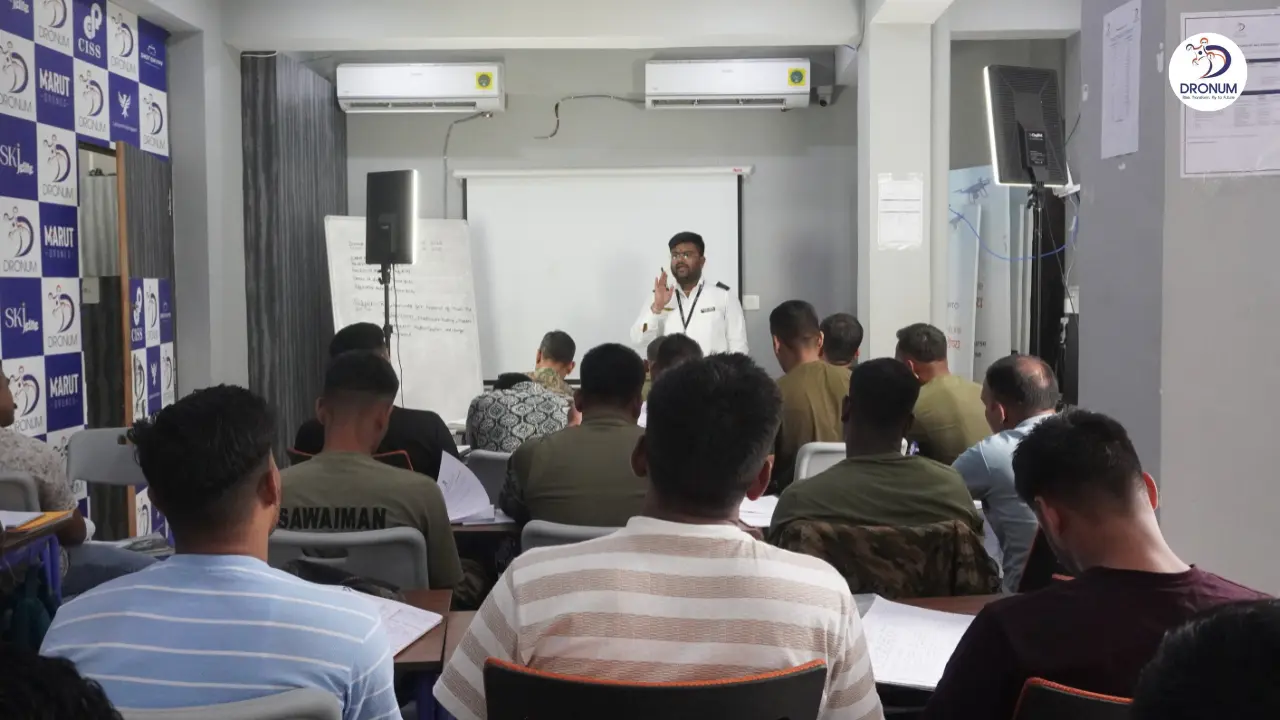
For the candidates preparing for the assessment, our approach focused on building understanding rather than encouraging rote learning.
A viva can expose the difference very quickly.
A candidate may remember a definition, but when the examiner asks a follow-up question or presents a practical situation, genuine understanding becomes essential.
That is why our preparation involved multiple layers.
Building the Theoretical Foundation
Candidates were guided through the relevant technical and operational concepts required for instructor-level understanding.The emphasis was on understanding concepts well enough to explain them in their own words.For a trainer, this matters enormously.If an instructor cannot explain a concept clearly, the learner is unlikely to understand it clearly either.
Technical Discussions
Technical discussions helped candidates strengthen their understanding and become comfortable discussing drone systems and operations from different perspectives.Instead of treating a topic as a fixed question-and-answer exercise, candidates were encouraged to understand the reasoning behind the subject.This approach becomes particularly useful during viva assessments, where one answer can naturally lead to another question.
Practical Exposure
Drone education cannot be effective if it remains entirely theoretical.Practical exposure helps candidates connect what they learn in the classroom with actual equipment and operational situations.Dronum’s wider training model incorporates hands-on flight and technical exposure, reflecting the organisation’s emphasis on practical capability development.
Safety and Regulatory Awareness
For a future instructor, safety cannot be treated as another chapter in a syllabus.It has to become part of the decision-making process.Candidates were therefore prepared to think about flight operations, safety procedures and regulatory compliance as interconnected aspects of professional drone operations.
Developing Communication Skills
One of the most overlooked aspects of becoming a trainer is communication.Knowing something and teaching it effectively are two different skills.Throughout the preparation process, candidates were encouraged to structure their answers, communicate clearly and remain composed while discussing technical subjects.The objective was to develop trainer confidence, not just examination confidence.
4. The Mock Viva: Preparing for the Real Pressure
The final stage of preparation was the mock viva.
For us, this was one of the most important parts of the entire process.
A classroom environment is predictable. A viva is not.
During a viva, a candidate has to listen carefully, understand exactly what is being asked, formulate an answer and communicate it confidently—sometimes while dealing with an unexpected follow-up question.
The mock viva was designed to recreate that environment.
Candidates faced:
- Technical questions
- Follow-up questions
- Cross-questioning
- Operational scenarios
- Safety-related situations
- Regulatory discussions
- Conceptual questions
- Communication-focused questioning
The intention was not to make candidates memorise a list of possible questions. Instead, we wanted them to become comfortable with thinking on their feet.That distinction is important.A good trainer cannot simply repeat a prepared answer. A trainer must be able to respond when a student asks, “Why?”, “What happens if…?” or “Can you explain this another way?”
The mock viva helped candidates experience precisely that kind of interaction.It also helped identify areas where additional preparation was required. Candidates could recognise where their answers were incomplete, where they were relying too heavily on memorisation and where they needed to improve their communication.
5. Learning Through Expert Interaction: Mr. Shailesh Chaturvedi
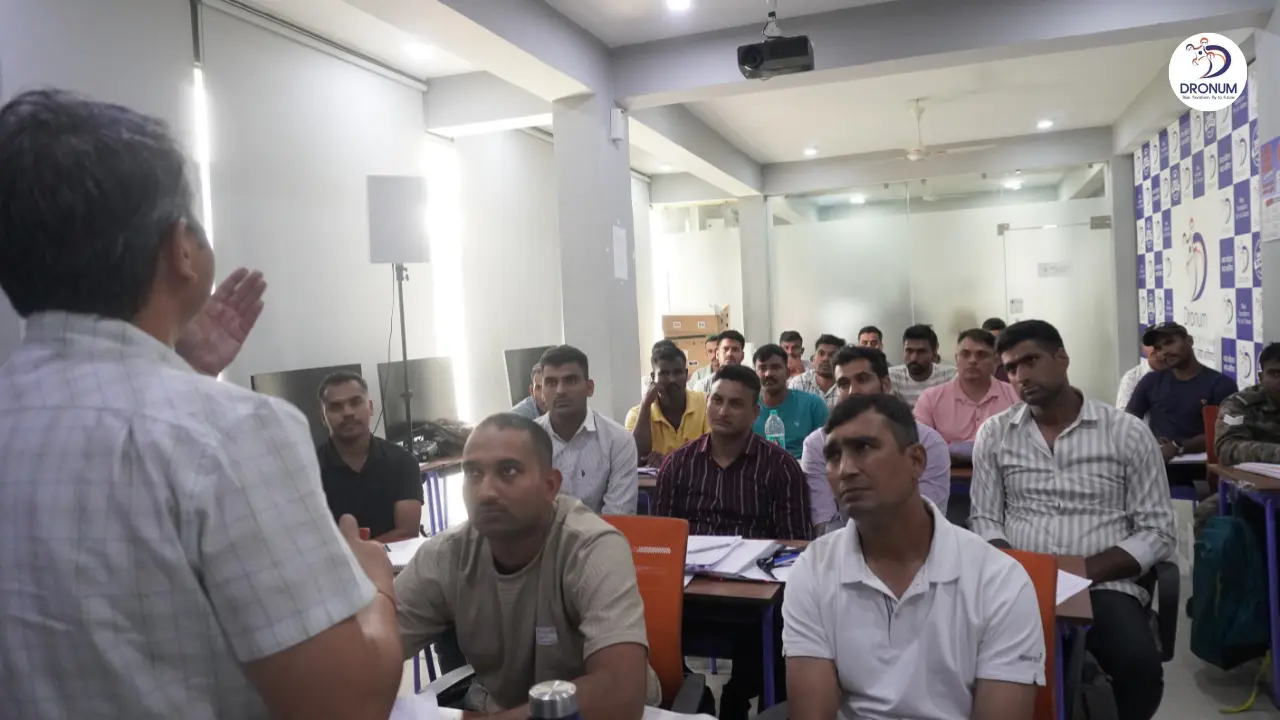
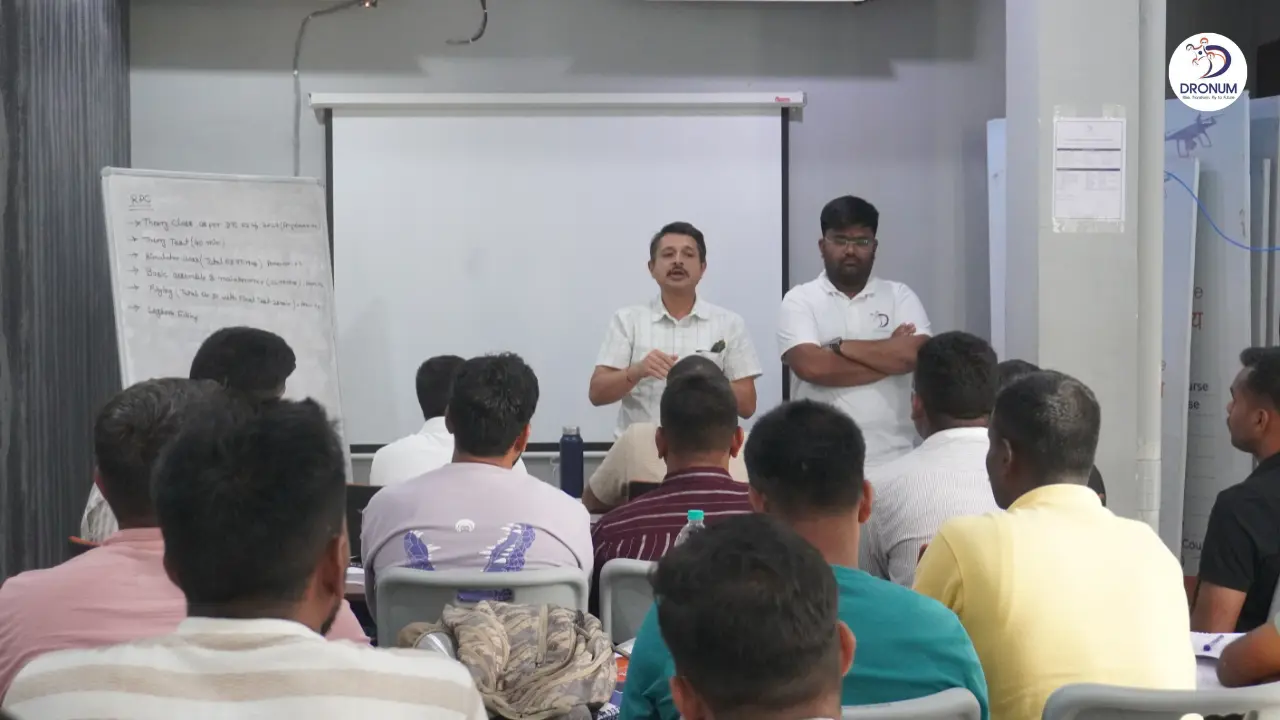
The mock-viva process was further strengthened by the participation of Mr. Shailesh Chaturvedi as a guest. His involvement brought an additional professional perspective to the interaction with candidates.The purpose of having an experienced professional participate was not simply to increase the number of questions.It was to make the interaction more realistic.Candidates had to respond naturally, explain their understanding and deal with questions from a perspective different from their regular classroom environment.
This kind of interaction can be particularly valuable for future trainers because it exposes them to the same kind of professional communication they will eventually need to demonstrate with their own students.Dronum’s company profile also identifies Col. Shailesh Chaturvedi within its management and technical ecosystem, including advisory and pilot-related responsibilities.
For the candidates, the mock viva became more than a rehearsal. It became an opportunity to understand what it means to communicate as a professional rather than simply respond as an examinee.
6. From Preparation Room to DGCA Viva
After weeks of preparation and mock-viva practice, the candidates progressed to the official assessment. The Directorate General of Civil Aviation (DGCA) published the results of the Remote Pilot Instructor (Rotorcraft–RPAS–Small Class) Oral Examination conducted during July 2026. The assessment was conducted across different dates and venues, with candidates receiving outcomes including Pass, Fail, Absent and Not Conducted/Not Qualified. The official result document demonstrates the scale of the assessment, with candidates appearing from different locations including Delhi, Bangalore, Chennai, Hyderabad and Mumbai.
For every candidate, the viva represented more than an examination.
It was an opportunity to demonstrate whether their technical knowledge, operational understanding and communication skills were ready for the responsibilities associated with instructor-level training.
7. What the July 2026 Results Tell Us
The numbers provide an interesting picture of the assessment.
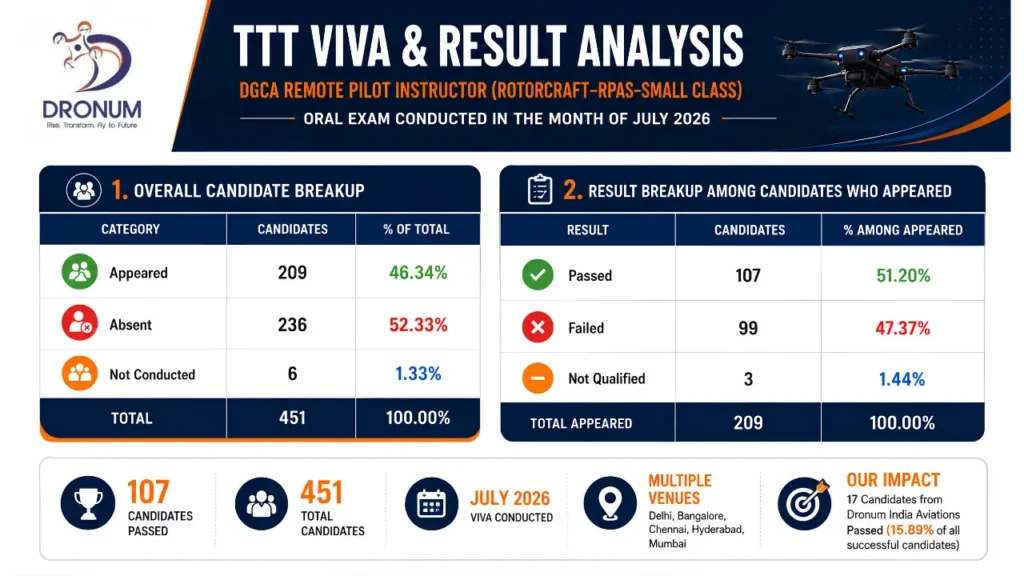
According to the result analysis, 451 candidates were part of the overall candidate pool.
8. The First Major Observation: Absenteeism
The first thing that stands out from the data is the 52.33% absenteeism rate.
Out of 451 candidates, 236 did not appear. That means the largest category in the overall candidate pool was not pass or fail, It was absence. This is important when interpreting the final result. The pass percentage of 51.20% should be understood as the pass rate among candidates who actually appeared, rather than 51.20% of the entire 451-candidate pool. This distinction matters when analysing examination performance.
9. Pass and Fail: A Closely Contested Outcome
Among the 209 candidates who appeared, 107 passed while 99 failed.
That means the difference between the number of successful and unsuccessful candidates was relatively small.The overall pass rate among those who appeared was 51.20%, while the failure rate was 47.37%.For us, this highlights an important point about instructor-level assessments.
The TTT and Remote Pilot Instructor pathway demands a deeper level of competency than simply knowing basic drone operations. Candidates have to demonstrate that they understand the subject well enough to communicate it and respond to questions that may move beyond straightforward recall. The relatively close pass-fail distribution reinforces the importance of serious preparation.
10. Dronum’s Contribution to the Successful Candidate Pool
One of the most significant figures from the analysis is Dronum’s contribution to the successful candidates.
17 candidates from Dronum India Aviations passed the assessment.
The overall number of successful candidates was 107.
Therefore:
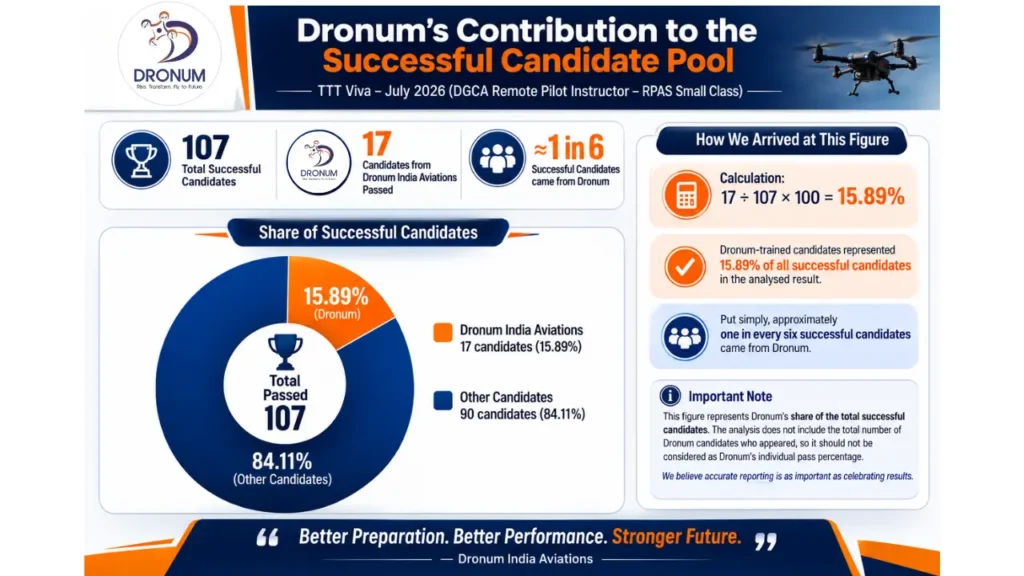
Dronum-trained candidates represented 15.89% of all successful candidates in the analysed result.
Put simply, approximately one in every six successful candidates came from Dronum.For our team, this is a meaningful outcome.However, there is an important distinction that we believe should be made when presenting the data.
The available analysis tells us Dronum’s share of the total successful candidates. It does not provide the total number of Dronum candidates who appeared. Therefore, it would not be appropriate to describe 15.89% as Dronum’s individual pass percentage.We believe accurate reporting is just as important as celebrating a result.
11. What This Result Means for Dronum
A result should never be viewed in isolation.
For Dronum, the 17 successful candidates represent the outcome of a broader preparation philosophy. The process was built around:
Learning → Understanding → Practising → Questioning → Mock Viva → Feedback → Improvement → Assessment
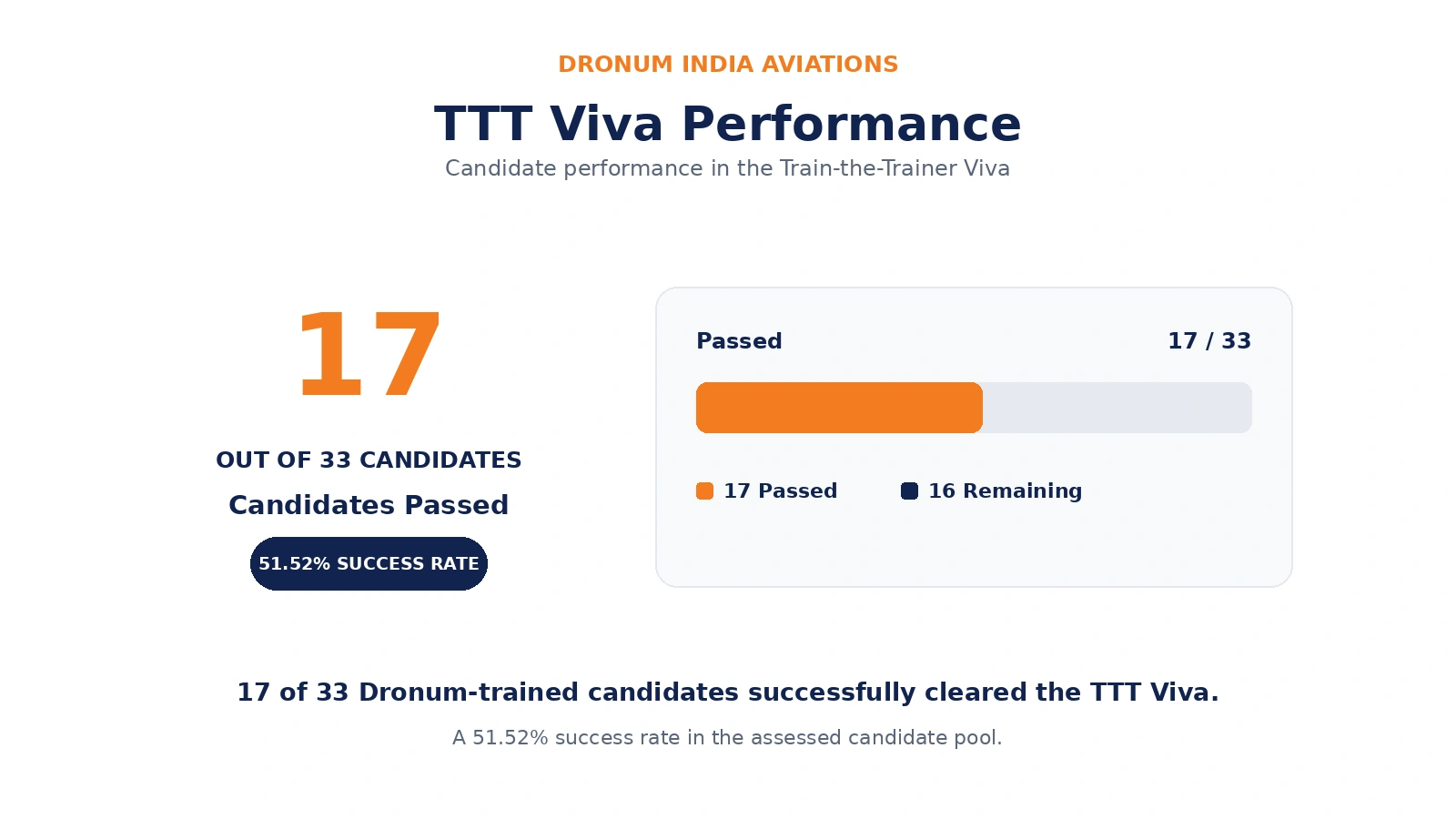
17 out of 33 candidates from Dronum India Aviations successfully cleared the TTT Viva, representing a 51.52% success rate. This result highlights Dronum’s focused preparation, structured training, and intensive mock-viva approach in preparing candidates for the assessment.
That sequence is important.The purpose of mock-viva training was never to guarantee a particular question would appear in the actual assessment.The purpose was to make candidates comfortable with the process of being questioned.It encouraged them to think rather than memorise, explain rather than repeat, and communicate rather than hesitate.These are exactly the qualities that a trainer needs in a real classroom.
Result_Small_July_26_Dronum12. The Bigger Picture: Why India Needs Better Drone Trainers
The Indian drone industry is no longer limited to enthusiasts and early adopters.Drones are increasingly becoming professional tools across multiple sectors.Surveying and mapping, agriculture, infrastructure inspection, security, disaster management and several other applications require trained personnel who understand both technology and responsible operations.As this ecosystem expands, the demand for trained Remote Pilots will naturally increase.And behind those pilots, there must be trainers.
That is why trainer development deserves greater attention.A capable trainer can influence an entire batch of future pilots. The quality of that trainer’s instruction can directly affect how those pilots approach safety, operations, technical decision-making and professional conduct.
In that sense, TTT is a multiplier programme.It does not simply develop one professional.It develops someone who can go on to develop many more.
Conclusion: Training the People Behind India’s Drone Growth
The July 2026 DGCA Remote Pilot Instructor viva was an important milestone for everyone involved.For the candidates, it was the final test of months of learning and preparation. For Dronum India Aviations, it was an opportunity to put our trainer-development approach into practice.
The numbers tell part of the story:
- 451 candidates in the overall pool.
- 209 candidates appeared.
- 107 candidates passed.
- 51.20% overall pass rate among those who appeared.
- 17 successful candidates from Dronum.
- 15.89% of the total successful candidates contributed by Dronum.
But behind those numbers are people who prepared, practised, answered questions, received feedback and walked into the viva with the responsibility of becoming trainers. That is what makes the TTT journey meaningful.
At Dronum India Aviations, we see drone education as more than certification. We see it as capability building.The industry needs pilots who can fly safely.It needs technicians who understand the machines they maintain.It needs professionals who can apply drones effectively in the field.And it needs trainers who can bring all of this knowledge to the next generation.The real success of a trainer is not measured only by what they know.It is measured by how many capable professionals they can help create and that is the direction in which we believe India’s drone training ecosystem must continue to move towards better preparation, stronger competency, safer operations and a new generation of professional drone trainers.